Why is water leaking through my ceiling after heavy Florida rain
A ceiling leak after heavy Florida rain almost always traces back to a failed flashing, pipe boot, or underlayment. Here is how to find the source and stop it.
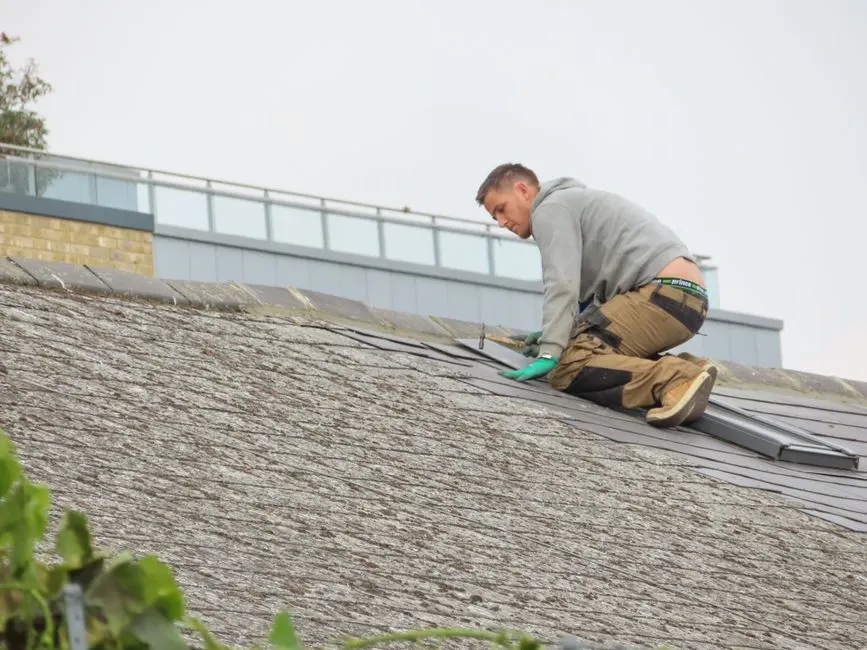
Water leaking through your ceiling after heavy Florida rain means storm water is getting past your roof's outer layers and running down the underside of your roof deck until it finds a seam, a light fixture, or a drywall joint to drip through. The leak is almost never directly above the wet spot - it enters higher up and travels sideways along rafters before it shows up on your ceiling. This article breaks down the six most common entry points we find on Florida homes, how to trace the real source, what to do in the first hour, and when a ceiling leak is a repair you can wait on versus one that needs a roofer today.
The short answer: Florida rain finds the weakest point in your roof
Why is water leaking through my ceiling after heavy rain in Florida? Because a Florida downpour delivers 2 to 4 inches of water in under an hour, and that volume pressurizes every gap in your roof system at once. A pinhole that stays dry during a light sprinkle becomes a steady drip when 60 mph wind drives rain sideways under a lifted shingle edge.
Ceiling water damage from a roof leak in Florida is a symptom, not the problem. The stain on your drywall is where the water finally escaped - the actual breach is usually 5 to 15 feet away, uphill, and hidden under shingles, tile, or flashing.
We have run leak calls across Florida for years, and the pattern is consistent: the wet spot on the ceiling is the exit, not the entrance. Find the entrance and the ceiling stops getting wet.
Why Florida rain is harder on roofs than rain almost anywhere else
Florida gets an average of 50 to 60 inches of rain a year, and most of it arrives in violent afternoon thunderstorms between June and September. That is roughly double the national average, delivered in fewer, heavier events.
Three things make Florida rain uniquely punishing on roofs:
- Volume in a short window. A single summer storm can drop 3 inches in 45 minutes. Roofs that shed light rain fine can be overwhelmed by that flow rate.
- Wind-driven rain. Florida storm cells routinely push 40 to 60 mph gusts. Rain does not fall straight down - it blows horizontally into flashing joints, vents, and valleys.
- UV and heat cycling. Between storms, your roof bakes at 140 to 160 degrees on the surface. Sealants, pipe boot rubber, and flashing caulk expand and contract daily until they crack.
That combination is why a roof that passed a visual inspection in March can leak in July. The materials did not fail overnight - they failed slowly and the storm found the failure.
If you are in one of the coastal or inland communities we serve, this pattern is even more pronounced. Homes near the water deal with salt air accelerating corrosion on metal flashing, while inland neighborhoods see wider temperature swings that crack sealant faster. We handle Roof Leak Repair in Sarasota and surrounding areas where salt exposure is a constant factor, and the flashing failures we find there are typically two to three years ahead of what we see 20 miles inland.
The six most common reasons water comes through your ceiling
After thousands of leak calls, these are the six culprits we find most often on Florida homes, roughly in order of frequency.
1. Failed pipe boot flashing
The rubber collar around your plumbing vent pipes cracks from UV exposure in 8 to 12 years. Once it splits, water runs straight down the pipe and into your attic. This is the single most common cause of a ceiling leak after heavy rain in Florida, and it is also the cheapest to fix.
2. Lifted or missing shingles
A 50 mph gust can peel the edge of an architectural shingle. The next storm drives water under the lifted tab and onto the underlayment. If the underlayment is also aged, water passes through to the deck.
3. Cracked flashing at walls, chimneys, and valleys
Flashing is the metal that seals the joints where your roof meets a vertical surface. The caulk and sealant on those joints has a service life of 5 to 8 years in Florida sun. When it fails, water enters horizontally during wind-driven rain.
4. Deteriorated underlayment
The felt or synthetic underlayment under your shingles or tile is your last line of defense. After 15 to 20 years, it becomes brittle and tears. Once it is compromised, any water that gets past the top layer goes straight into your attic.
5. Clogged or failed valley and gutter drainage
When gutters back up, water pools at the roof edge and wicks under the first course of shingles. We see this constantly on homes with mature oak or pine trees nearby.
6. Skylight and chimney seals
Skylights and chimneys rely on a layered flashing system. Any one layer failing - the curb flashing, the step flashing, or the sealant - opens a path for water.
How to tell where the water is actually getting in
You can narrow down the source yourself before anyone climbs a ladder, and that saves time on the repair.
Start in the attic during or right after a storm. Look for:
- Dark streaks or staining on the roof deck. The stain marks the path water is taking. Follow it uphill.
- Daylight through the roof boards. If you can see light, water can get in.
- Wet insulation. Push back insulation batts near the leak - water often travels along the top of the insulation before dripping.
- Rusty nail heads. Rust on the underside of the deck means chronic moisture, not a one-time event.
On the roof itself, the tell is usually staining or corrosion around a penetration - a pipe boot, a vent, a chimney, or a skylight. If the ceiling stain is within 3 feet of a plumbing vent stack, the pipe boot is your first suspect.
One caution: do not walk a wet roof. Tile and shingle surfaces are slick after rain, and Florida roofs are steeper than they look from the ground. Visual inspection from the attic and the ground is enough to narrow it down.
What to do when water leaks through ceiling in Florida
When water leaks through ceiling in Florida, the first hour matters more than the next three days. Here is the sequence we recommend to every homeowner who calls us mid-storm.
- Move furniture and electronics out from under the drip. Water and electronics do not mix, and a soaked rug becomes a mold problem within 24 to 48 hours.
- Put a bucket down and lay towels. Sounds obvious, but containing the water prevents a much larger drywall and flooring repair.
- Poke a small drain hole in a bulging ceiling. If the drywall is sagging under the weight of trapped water, a clean 1/4-inch hole in the center of the bulge releases it in a controlled way instead of letting the whole sheet collapse.
- Turn off power to affected ceiling fixtures at the breaker. Water and live wiring are a genuine hazard.
- Take photos and video. You will want them for your insurance claim, and they help the roofer see what happened before the evidence dries.
- Call a roofer for emergency roof leak repair in Florida. A temporary fix during the storm prevents the damage from compounding.
If the leak is active and the storm is still going, the goal is containment, not repair. Nobody should be on your roof in 50 mph wind. Emergency roof tarping after the storm passes is the right next step - it stops additional water from entering while you wait for a permanent fix.
For homeowners across the state, we handle Roof Leak Repair in Florida with same-day response on active leaks, and we can usually tell you over the phone whether the situation needs a tarp tonight or a repair tomorrow.
Common mistakes homeowners make with a ceiling leak
We see the same five mistakes over and over, and each one turns a $400 repair into a $4,000 problem.
- Painting over the stain without fixing the leak. The stain comes back within weeks, and the moisture keeps rotting the deck and insulation in the meantime.
- Sealing the roof from the ground with a tube of caulk. You cannot see the actual breach from the ground, and roof sealant applied to a wet surface fails within days.
- Waiting for the next storm to confirm it. By then, mold is growing in the attic. Mold can establish in 24 to 48 hours in Florida humidity.
- Assuming the leak is directly above the stain. Water travels. The entry point is often 10 feet uphill from the drip.
- Filing an insurance claim before getting a professional assessment. Many ceiling leaks are maintenance issues, not covered storm damage. Knowing which one you have before you call your insurer saves you a claim on your record.
That last point matters. A pipe boot that cracked from UV aging is a maintenance failure. A shingle torn off by a named storm is usually covered. The difference is thousands of dollars, and it comes down to what caused the breach.
When to call a professional
Call a roofer the same day if any of these are true:
- The leak is active and you cannot contain it with a bucket.
- The ceiling is sagging, bulging, or visibly bowing.
- Water is anywhere near a ceiling fan, recessed light, or electrical outlet.
- The stain is growing during the storm, not just after.
- You have already patched it once and it came back.
At Weatherproof Roofing Inc, we start every leak call with a full roof and attic inspection so we can show you exactly where the water is entering. We find the leak, fix it, and test the repair with a hose before we leave. You get upfront pricing before any work begins, and we tell you honestly when a repair is not the right answer and a larger fix is needed.
If your leak traces to a specific system, we handle it directly. Failed pipe boots get a full pipe boot repair in Florida with UV-rated replacement collars. Cracked wall or chimney flashing gets a roof flashing repair in Florida using new metal and fresh sealant rated for Florida sun. And if the storm tore shingles loose, we handle missing shingle roof repair in Florida to restore the top layer before the next system rolls through.
Frequently Asked Questions
Why is water leaking through my ceiling after heavy rain in Florida?
Water is getting past your roof's outer layers and running down the deck until it finds a seam to drip through. In Florida, the cause is usually a cracked pipe boot, lifted shingle, or failed flashing - not a hole directly above the stain. The entry point is typically 5 to 15 feet from the drip.
How do I stop a ceiling leak during a Florida storm?
Contain it, do not try to repair it mid-storm. Move valuables, place buckets, poke a small drain hole in any bulging drywall, and cut power to affected fixtures. Nobody should be on a roof in 40+ mph wind. Call for emergency tarping once the storm passes, then schedule the permanent repair.
Does homeowners insurance cover ceiling leaks from rain in Florida?
It depends on the cause. Sudden damage from a named storm or a fallen branch is usually covered. Gradual deterioration - a pipe boot that cracked from UV aging, worn underlayment, or failed caulk - is typically treated as a maintenance issue and denied. Get a professional assessment before filing so you know which category your leak falls into.
How much does roof leak repair cost in Florida in 2026?
Typical 2026 pricing in this area runs $350 to $850 for a pipe boot or flashing repair, $600 to $1,500 for shingle repair on a small section, and $1,200 to $3,500 when underlayment replacement is needed. Emergency tarping usually runs $400 to $900 depending on roof size and pitch.
Can a ceiling leak fix itself?
No. A ceiling leak that stops between storms has not healed - the breach is still there, waiting for the next heavy rain. In Florida humidity, mold can establish in the wet attic space within 24 to 48 hours. Delaying the repair typically doubles or triples the total cost.
Get help with Roof Leak Repair in Florida
If water is coming through your ceiling after a Florida storm, we can find the source and stop it before the next one hits. Our team handles everything from a single pipe boot to full flashing and shingle repair, with upfront pricing and same-day response on active leaks.
Call Weatherproof Roofing Inc at (833) 356-1017 and we will get a roofer out to your home.